Philosophy for All Fargo-Moorhead is open to everyone interested in philosophy. Its aim is to approach philosophical problems in a non-technical way to enable everyone to participate in discussion and debate. It aims to combine serious philosophical activity with an informal exchange of ideas and views. We typically meet on the 3rd Thursday of the month from 7-9 PM at The Plains Art Museum in Fargo, ND, USA.
Upcoming Topics
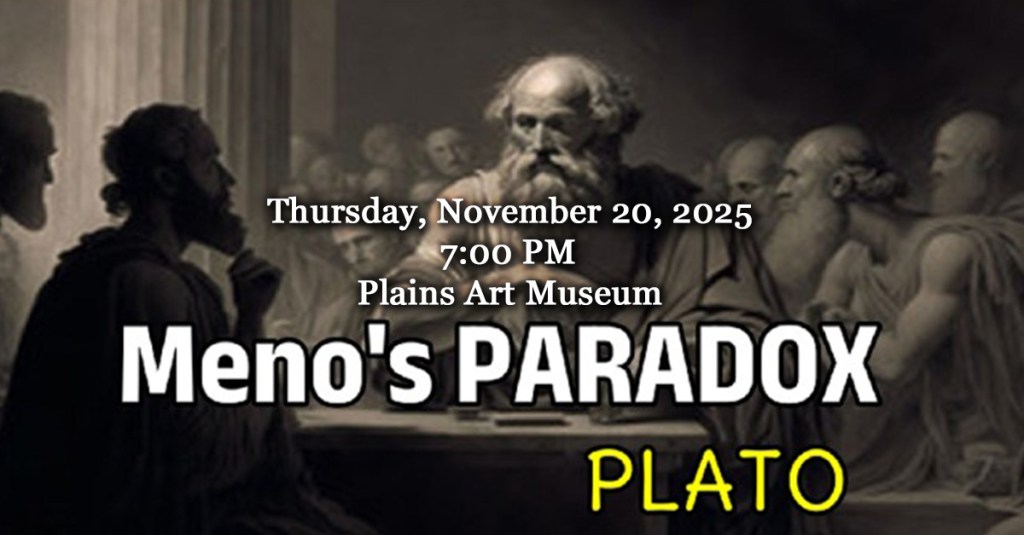
Meno’s Paradox
Thursday, November 20th, 2025, 7-9 PM
Plato’s Meno dramatizes the challenge of a powerful skeptical paradox. Meno’s paradox attacks the popular assumption that we can acquire knowledge by means of inquiry. The specific target of Meno’s argument is inquiry about the nature of human excellence, but the problem generalizes to cover the possibility of acquiring knowledge about any topic, call it ‘X’:
How will you look for it [X], Socrates, when you do not know at all what it [X] is? How will you aim to search for something [X] you do not know at all? If you should meet with it [X], how will you know that this [X] is the thing that you did not know? (Plato, Meno 80d, Grube translation)
To make this more familiar, think about looking for your keys. You can’t recall where you left them, and you start looking for them around your house, in the places you typically leave them. If you find them, it is because you do know what your keys look like. Only thus do you recognize them when you finally lay eyes on them. That means finding presupposes already knowing what you are looking for. But when what we are looking for isn’t a thing (like keys) but knowledge of some sort (in the case of the Meno, knowledge of what it is to be excellent), then we can only find what we are looking for if we already know what we are looking for. And then we aren’t finding it because we already know it! What are we to make of this Catch-22?
Presented by Andrew D. Cling.
Recent Topics

Carus Lecture in the Philosophy of Law: Sustaining Institutions: Faith and Practice
Thursday, Oct 16th, 2025, 7:30 PM, Concordia College
For October’s meeting we will be joining a lecture in the Centrum, Knutson Campus Center, at Concordia College, 624 9th Ave S, Moorhead, MN.
The presenters will be two Concordia alumni: Peter Hatinen ’96 and Eric Wolff ’95. Together, they will explore the intersection of law, philosophy, and the role of institutions in society.

The Central Idea in Confucius’ Moral Vison: The Gentleman
Thursday, September 18, 2025, 7–9 PM
Confucius (Kongzi) is undoubtedly among the most important moral thinkers of human history, with his thought fundamentally shaping not only Chinese culture but also a number of other Asian cultures, notably those of Japan, Korea, and Vietnam. As important as Confucius is, his key text, The Analects, is not an easy book for Westerners to read. It is composed of a large number of short epigrams and stories which are often cryptic and apparently disconnected. (In Classic Asian Philosophy, Joel Kupperman irreverently said that they can read like demented fortune cookie messages!) Tonight’s discussion will focus on a central passage in the Analects (6.18). This passage identifies the key features that make Confucius’s ideal person, the gentleman (junzi). By focusing on this passage and by bringing in other passages to illuminate it, we will get an idea of who this Confucian gentleman is. We will also discuss whether this ideal remains relevant for us today or whether the gender and class associations of a term such as “gentleman” are too much of an obstacle. Presented by Dr. George Connell

Philosophy of Leisure
Thursday, July 17, 2025, 7–9 PM
How’s your work-life balance? That has become a common phrase representing people’s struggle to balance work and personal priorities. Within the “life” part of the equation are many things, including leisure activities. What exactly is leisure, how should we think about it, and how should it be prioritized? We’ll watch a short video on the subject (https://youtu.be/wzWnTpxUKNg), look at the thinking of philosophers Joseph Pieper and Kieran Setiya, and have a group discussion.

Socrates Café
Thursday, June 19, 2025, 7–9 PM
Join us for a spirited philosophical discussion on whatever topic is selected by the attendees of the meeting. No particular background is needed, just an interest in rational discussions about interesting topics.
June’s topic was “What does it mean to ‘be yourself’ and is it a good thing to do?”

Ethics of Human Gene Editing
Thursday, May 15, 2025, 7–9 PM
New techniques for making changes to the information encoded in human genes show promise for treating serious diseases, but also raise a number of issues in the realm of biomedical ethics. We will discuss basic information about gene editing and then explore some of the controversies associated with current and potential future applications of this technology.
The presentation will be given by Ellen Aho. Dr. Aho recently retired from the Biology Department at Concordia College, where she taught courses in genetics, microbiology, and bioethics.
Photo source: https://www.nih.gov
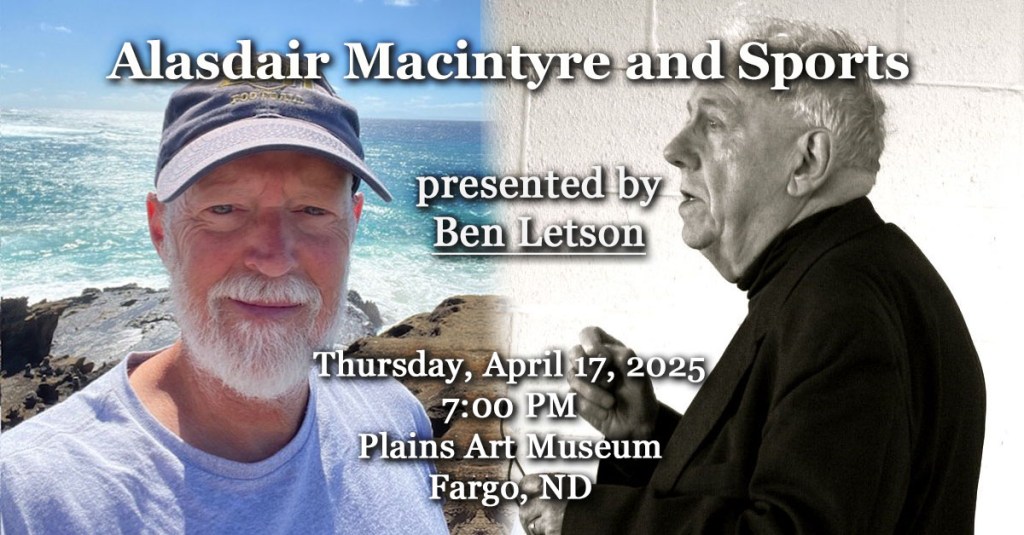
Alasdair Macintyre and Sports
Thursday, April 17, 2025, 7–9 PM
The moral philosophy of Alasdair MacIntyre can help us make sense of a number of ethical issues plaguing the contemporary practice of sport. Ben Letson (pictured), who has recently retired from Emory & Henry University, will briefly discuss MacIntyre’s virtue ethics and ask whether his analysis of the nature of practices can help us improve our understanding of, and participation in, sports.

Stoicism
Thursday, March 20, 2025, 7–9 PM
Over the past decade, Stoicism has experienced a resurgence in popularity. With this renewed interest in a philosophy that spans more than two millennia, however, come questions, misconceptions, and misapplications of its core teachings. This talk aims to clarify and deepen our understanding of Stoicism, offering an introduction for newcomers and a thoughtful refresher for those already familiar with its principles. We will briefly explore the history of Stoicism, examine its central tenets, and discuss how these ideas can be effectively applied in the modern world to help us lead more fulfilling and purposeful lives.
Presentation by Maxx Kureczko, NDSU Mathematics Dept.
Socrates Café
Thursday, February 20, 2025, 7–9 PM
Join us for a spirited philosophical discussion on whatever topic is selected by the attendees of the meeting. No particular background is needed, just an interest in rational discussions about interesting topics.
February’s topic was “Is it justifiable to pursue pleasure?”

Keeping Cool Amid the Climate Crisis
Thursday, January 16, 2025, 7–9 PM
Eco-anxiety is on the rise, but Dr Britt Wray’s revolutionary research on the psychological toll of climate change reveals a surprising truth; that embracing climate anxiety can help solve both mental health and ecological problems. In her talk at Frontiers Forum Live 2023, Britt explored how today’s ecological crises can push us into a state of grief, numbness, or fatalism, causing burn out and making us question big life decisions such as whether to have children. She also revealed how this grief can mobilize and transform us, emphasizing what we can do to control it and its power to spark transformational change.
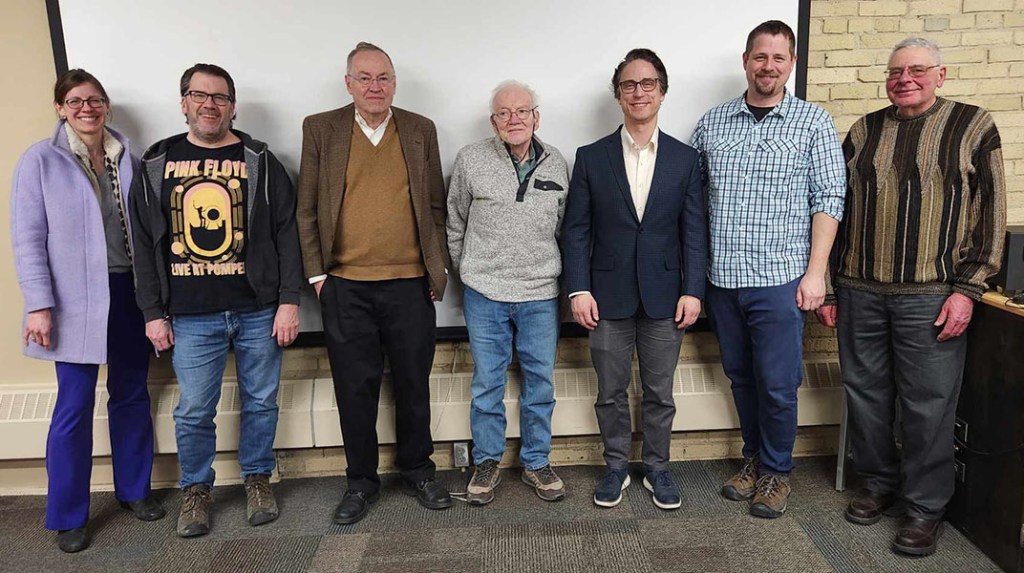
Philosophy for All Fargo-Moorhead celebrated its 20th Anniversary in 2024!
Some of our regulars posed for a photo after February’s meeting: Gwen, Paul, George, Mark, Bruce, Richard, and Oryn.
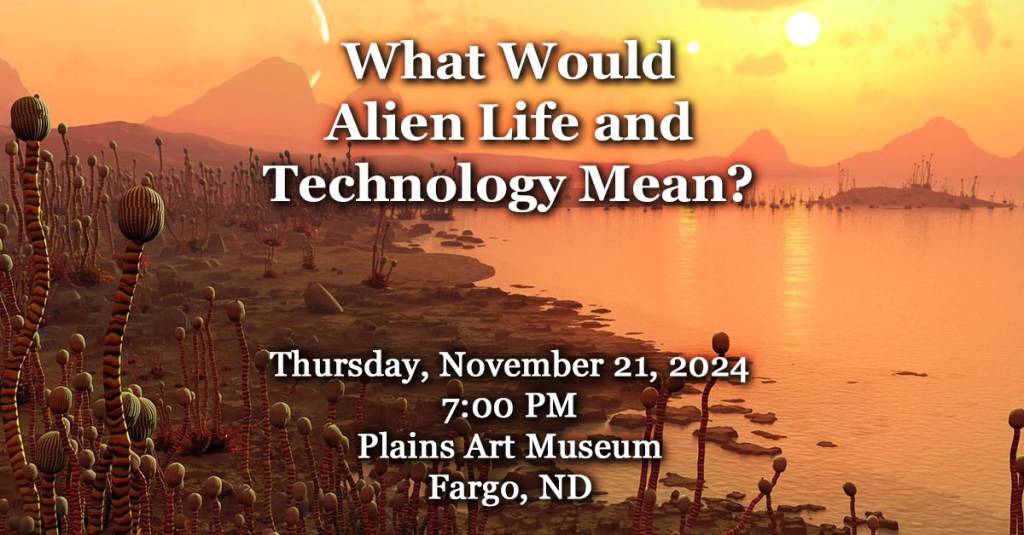
What Would Alien Life and Technology Mean?
Thursday, November 21, 2024, 7–9 PM
What could life be as we don’t know it? Three transitions in astrobiology. Non-life to life. Life to intelligent life. Intelligent life to technological civilization. For alien life, would Darwinian evolution hold? We ask these and other questions after watching the above named video hosted by Robert Lawrence Kuhn.

Russell’s Paradox – a simple explanation of a profound problem
Thursday, October 17, 2024, 7–9 PM
Bertrand Russell (1872-1970) was a British philosopher and mathematician who discovered a paradox in set theory in 1901: This paradox is a contradiction that arises when considering the set of all sets that are not members of themselves. The paradox is that the set appears to be a member of itself if and only if it is not a member of itself.
If that doesn’t make complete sense, don’t despair! Come join us in watching the video “Russell’s Paradox – a simple explanation of a profound problem” hosted by Jeffrey Kaplan. Group discussion follows the video.
Socrates Café
Thursday, September 19, 2024, 7–9 PM
Join us for a spirited philosophical discussion on whatever topic is selected by the attendees of the meeting. No particular background is needed, just an interest in rational discussions about interesting topics.
September’s topic was “At what point does skepticism become problematic?”
Socrates Café
Thursday, August 15, 2024, 7–9 PM
Join us for a spirited philosophical discussion on whatever topic is selected by the attendees of the meeting. No particular background is needed, just an interest in rational discussions about interesting topics.
August’s topics were “Why is so much contemporary lit and film (esp for young people) very dystopian and apocalyptic?” and “Marriage – Good idea? Bad idea?”

Danto’s versions and Taylor’s versions
Thursday, July 18, 2024, 7–9 PM
In 1981, Arthur Danto defended a complex point about art and art interpretation by discussion a series of identical paintings that were nothing but square, red canvasses. He called them “indiscernible counterparts.” One implication is that none of these squares can be substituted for the artistic achievement of another of them. Indiscernible does not mean interchangeable. In 1996, Theodore Gracyk applied Danto’s insight to popular music using several possible cases of re-recorded music. However, these were mere thought experiments. Recently, Taylor Swift has created Taylor’s versions, a project of re-recording her first six albums. What did Danto say, and what implications does this have for Taylor’s Versions?
Presented by Theodore Gracyk; Co-Chair of the Department of History, Languages, and Humanities at MSUM
If you would like the Zoom link, email us at info@philosophy-for-all-fm.com . Participation may be limited due to most attendees being at the museum.
Socrates Café
Thursday, June 20, 2024, 7–9 PM
Join us for a spirited philosophical discussion on whatever topic is selected by the attendees of the meeting. No particular background is needed, just an interest in rational discussions about interesting topics.
June’s topic was Free Will.

Freedom of Speech in the Modern World
Thursday, May 16, 2024, 7–9 PM
Limits to freedom of speech is a hot topic today, driven by events such as the recent campus protests, political sparring, and social media restrictions. Does limiting free speech make the world safer or more dangerous? We’ll start the meeting with a short video that reviews John Stuart Mill’s thinking on free speech, and then continue with an open discussion on how those principles stack up in the real world conflicts of today.
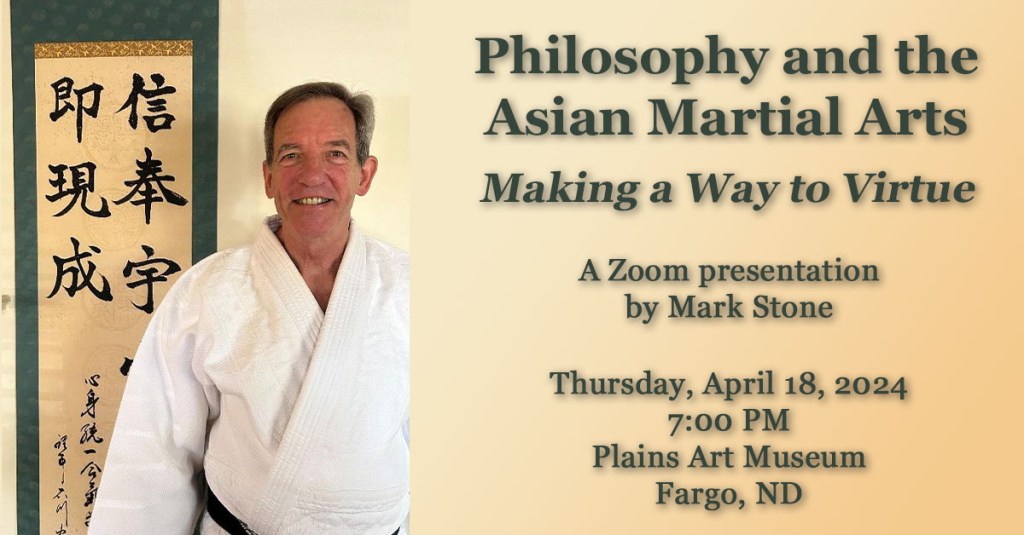
Philosophy and the Asian Martial Arts – Making a Way to Virtue
Thursday, April 18, 2024, 7–9 PM
Join us in person or on Zoom (hybrid meeting) for an exploration of the philosophical connections between self-cultivation, martial arts, and moral virtue. Presented by Mark Stone of Furman University.
Please request the Zoom link via email or through Facebook. It will be sent out within 24 hours of the meeting. info@philosophy-for-all-fm.com
Zoom participation may be limited as we have had some issues in the past with sound.
Socrates Café
Thursday, March 21, 2024, 7–9 PM
Join us for a spirited philosophical discussion on whatever topic is selected by the attendees of the meeting. No particular background is needed, just an interest in rational discussions about interesting topics.
March topics included “What is the origin of creativity?” and “Can it be unethical to be too nice?”

Pragmatic Themes in the Philosophy of William James
Thursday, February 15, 2024, 7-9 PM
Join us for a session of philosophical inquiry into the Pragmatic philosophy of William James, with a sprinkling of Nietzsche. For this meeting we will be listening to portions of a lecture give by Dr. Darren Staloff about several important ideas of William James and the American Pragmatists that distinguished American philosophy from its European roots, including on the topics of: perspective, truth, and humanism. No particular background is needed, however the lecture content is relatively academic. The meeting will seek to inquire and understand the ideas of Pragmatism through listening and periodic discussion.
In addition to this topic, we’ll celebrate the 20th anniversary of Philosophy For All – Fargo Moorhead.
 Philosophy for All Fargo-Moorhead